Tandem

An AI copilot that turns a teacher's classroom observations into warm, plain-language messages parents understand, and a plan they build together.

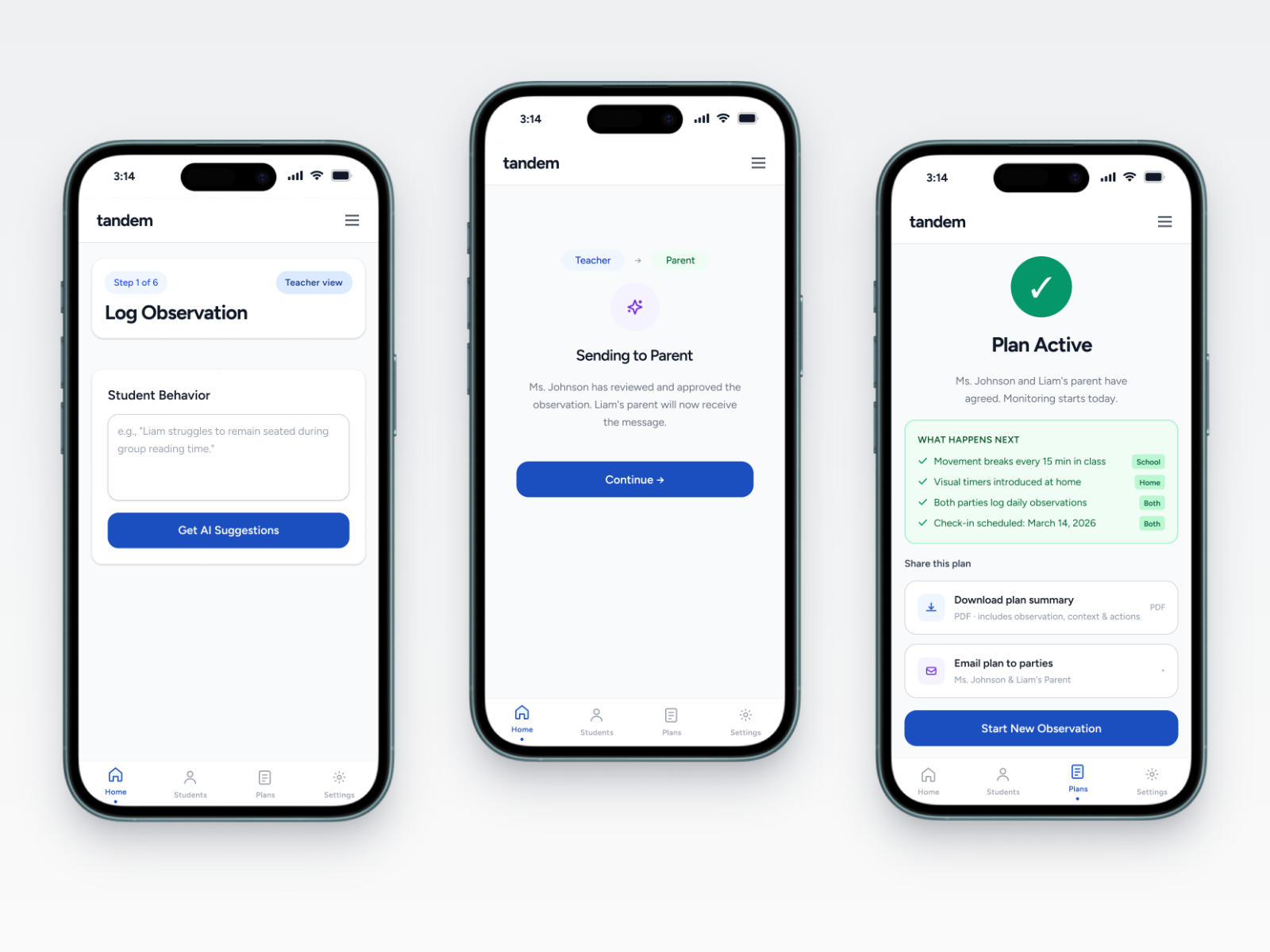
Tandem: the teacher-and-parent app across observe, communicate, and shared-plan screens

Team of 5

~5 weeks

Figma · Figma Make · ChatGPT · Claude

Research synthesis · AI prototyping · Risk evaluation

~7 min read· 7 sections· Read the bold lines for the 60-second version
01 · Snapshot

A responsible AI copilot that turns a teacher's observations into a shared, plain-language conversation, without ever diagnosing.

Challenge

Parents and elementary teachers get about 40 minutes of contact a year. In that gap, brief feedback gets misread, parents feel blindsided, and small concerns harden into anxiety before anyone aligns.

Solution

An AI copilot on three bets: a guided observe → communicate → act journey, an AI that translates "teacher-speak" into warm language (never diagnosing), and a shared action plan across home and school. The teacher stays in control; the AI stays a draft.

My role

On a team of five: synthesized the formative research, prototyped the end-to-end flow, and led the AI heuristic & ethical-risk evaluation.

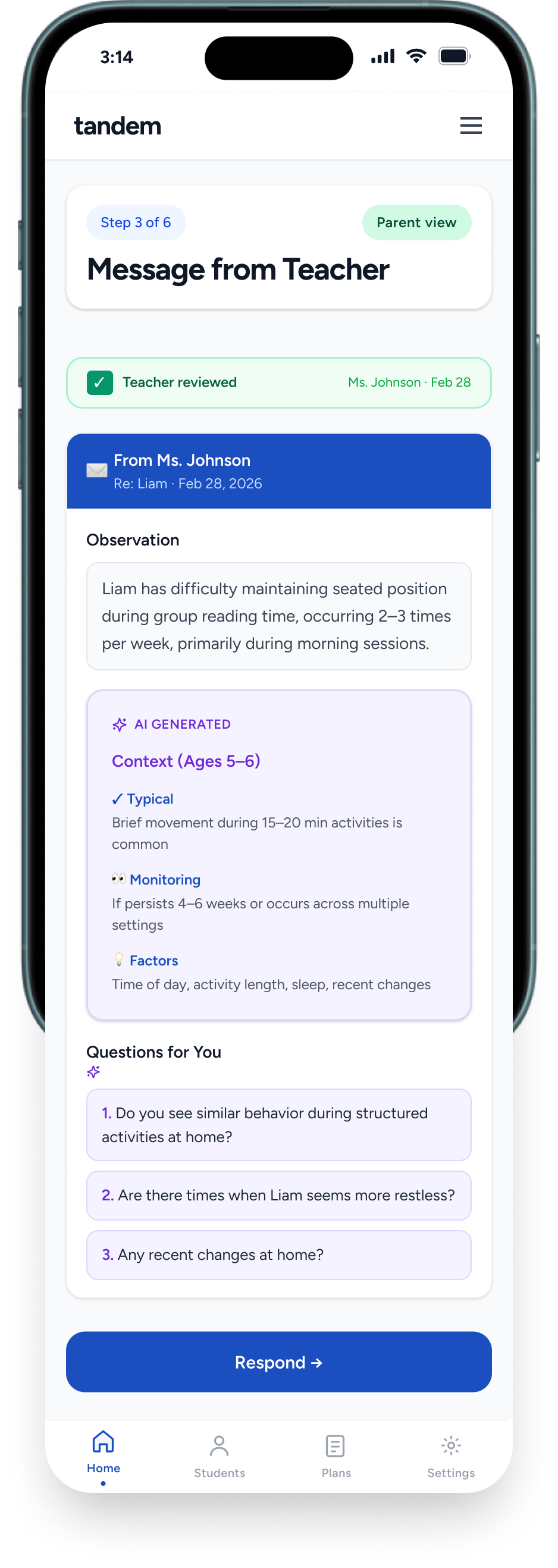
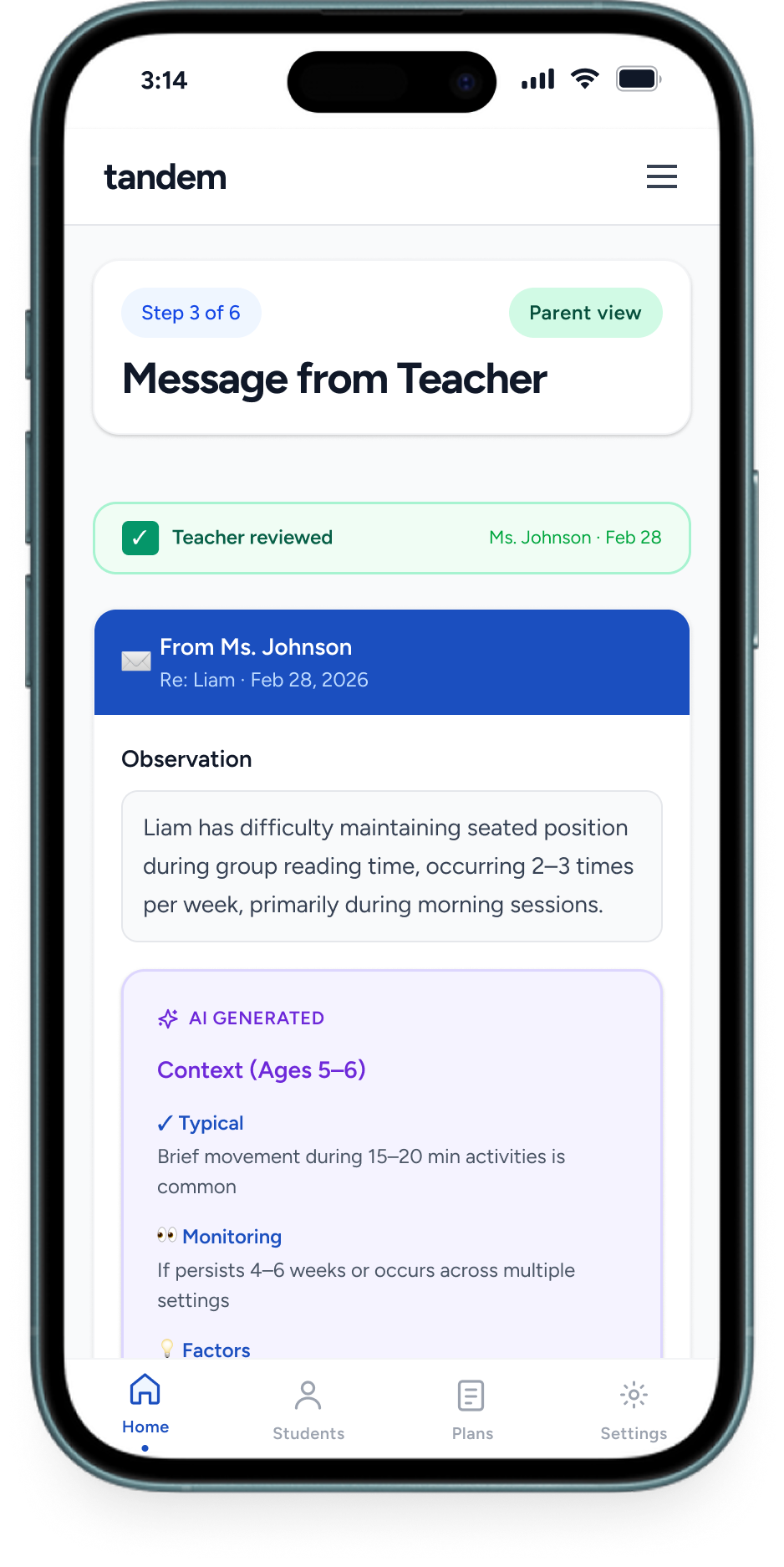
Message from Teacher: the parent's view

Message from Teacher: the parent's view

40 minteacher contact per family, a year
20+families a teacher juggles at once
3AI personas stress-tested the concept
6peer-reviewed sources behind it

The honest challenge

We tested mostly on AI-simulated users. They exposed real edge cases but reacted a shade too neatly, and a reworded prompt could flip them. I read them as hypotheses, not proof; no real classroom has met this yet.

02 · Problem

Two people who love the same child, speaking two different languages.

Teachers observe carefully and parents care deeply; the information exists. What's missing is a shared, low-stakes way to reconcile two views of the same child before a concern becomes a crisis.

What the teacher sees

Structured behavior in the classroom: focus, peer interaction, how a child handles group time.

One child the gap

What the parent sees

A different world at home (routines, mood, what the day cost), with no window into the classroom.


The same child, two contexts, no shared view.
The teacher and the parent each hold half the picture, with no low-stakes way to reconcile them.

40min

of direct teacher contact per family in an entire year; the whole relationship runs on it, so feedback is rationed and deferred.

01Brief, fragmented feedback parents can't act on.
02Pedagogical language that reads as alarming out of context.
03Concerns surface late, at conferences, when they already feel like problems.
04Parents backfill the gaps with anxiety-driven online searches.

The same child ends up living in the gap between two incomplete pictures.

03 · Research

Three methods aimed at one gap: why does it persist, and what closes it?

We went wide before proposing anything, pairing AI-assisted synthesis with human judgment: AI summarized and clustered the sources, and I made the interpretation calls by hand.

3methods triangulated
6peer-reviewed sources
2frontline interviews
The three methods

Each method answered its own question. Click any one to see what we did and what we found.

Reviewed six peer-reviewed sources on parent–teacher communication and child development: AI summarized and compared them, human judgment clustered the themes.
  • Greater parent–teacher perception gaps correlate with lower social and cognitive outcomes; the misalignment itself has measurable consequences (Jensen et al., 2025).
  • The early-elementary years (ages 3–10) are a critical, high-impact window for getting alignment right.
  • Parents and teachers define "engagement" differently, so each can read the other as not involved enough (Fisher & Baissberg, 2025).
  • Low-stakes, ongoing communication reduces defensiveness more than scheduled conferences (NAEYC).
A semi-structured interview with a mother of two children (ages 5 and 7) in a private-school setting.
  • Relies primarily on biannual conferences; contact outside them is reactive.
  • Has limited visibility into the child's social world at school.
  • Fills knowledge gaps with online searches and parenting forums, which amplify anxiety.
  • Asked, unprompted, for structured question prompts to bring to conferences.
A semi-structured interview with an early-elementary teacher about how they raise and frame concerns with families.
  • Waiting until conferences makes parents feel blindsided; early, low-stakes notes reduce defensiveness.
  • "Productive struggle" and routine developmental comments are frequently misread as alarming.
  • Time is the hard constraint: roughly 40 minutes of direct contact per family, per year.
  • Parents have almost no window into the classroom's social landscape.
Key findings

Across the literature and both interviews, three insights defined what the design had to do:

01

The gap is structural, not personal

Both adults care; they observe the child in different contexts with no way to reconcile views. The fix is a shared framework, not more goodwill.

02

Translation is the bottleneck, not information

Teacher language triggers parent anxiety. The missing piece is a reliable bridge from professional terms to plain, supportive meaning.

03

Reactive timing feels like a verdict

Saved up for conferences, feedback lands as a high-stakes surprise. Continuous, low-stakes contact lowers the temperature.

These three findings pointed straight at a communication tool: one that translates, paces, and aligns.

04 · Design

Three barriers became three design decisions, each with a hard rule the AI had to follow.

Research pointed to three barriers: teacher language triggers anxiety, feedback is saved up until it lands as a verdict, and teachers have minutes, not hours. Each became a decision below.

Decision · 01

A guided observe → communicate → act journey

Insight

Communication happens all at once, late, at conferences, so teachers are time-poor and parents feel blindsided.

Decision

Break the exchange into a calm, multi-step journey that mirrors how a concern actually unfolds.

Solution

Nine screens grouped into three acts, each doing a single, low-stakes job:

  1. Observe: the teacher logs the concern, frequency, examples, the child's strengths, and what they've tried.
  2. Communicate: the AI drafts the message; the teacher reviews and approves, then the parent receives it in plain language, with developmental context and a few questions to answer.
  3. Act: the parent adds their home perspective, and both sides build an editable plan together.

Outcome

The journey mirrors how a concern surfaces (notice, talk, act), so neither side carries the whole conversation at once. Later evaluation bore this out: both the real-teacher walkthrough and the synthetic personas gravitated to the structure.

3 acts
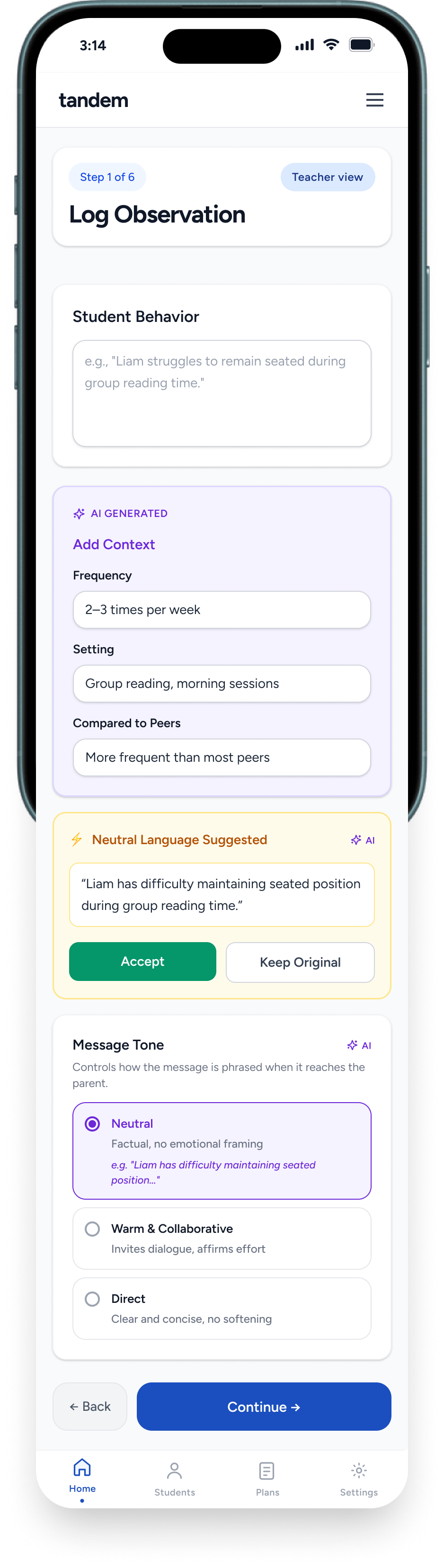
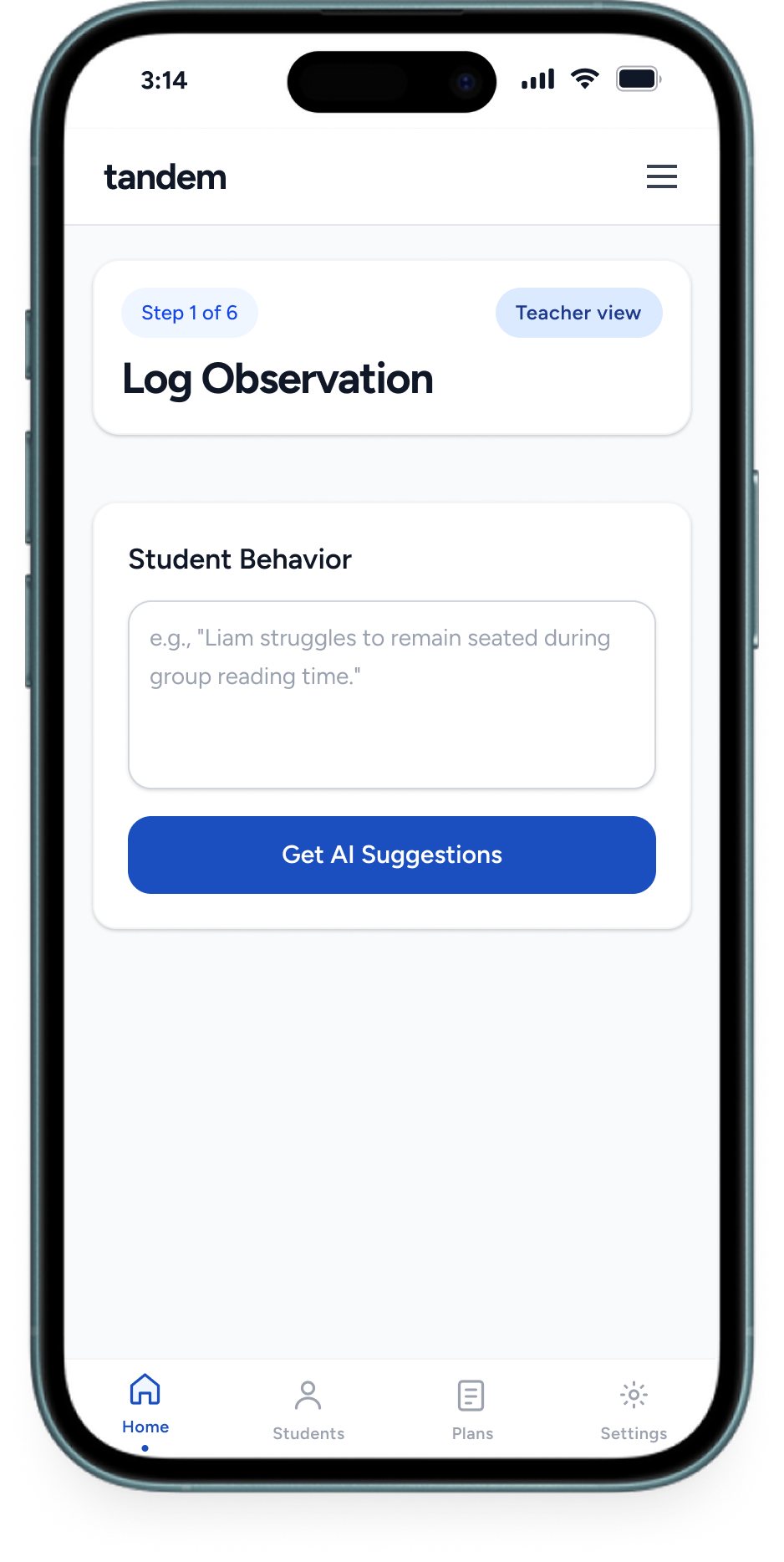
Observe: teacher logs an observation with behavior, frequency, context, and tone

Observe: the teacher logs one structured observation.
Decision · 02

An AI copilot that translates, never diagnoses

Insight

The core problem is translation. Professional language triggers parent anxiety. And in a child-behavior context, an AI that sounds clinical is dangerous.

Decision

Make the AI a copilot that turns structured teacher notes into warm, plain-language messages, with the teacher always in the loop and hard limits on diagnostic language.

Solution

The copilot is the primary pattern; two supporting patterns make it trustworthy:

  1. Explainability: a "How this message was created" panel surfaces the observations and patterns behind the draft, so the reasoning is visible, not hidden.
  2. Controllability: tone control and regenerate; the model proposes, the teacher decides.
  3. Human-in-the-loop: nothing sends unreviewed; every draft is edited and approved first.

The hard rule: Tandem never diagnoses, labels, or names conditions. It translates into strength-based, developmentally grounded language and points to professionals when a concern is serious.

Outcome

This is where the biggest risk lived: an AI that sounds clinical. So the copilot leads with the transparency panel and a bias-aware language safeguard, and the fix was never a smarter model, it was keeping the human in front of it. Our later evaluation put exactly this to the test.

The copilot

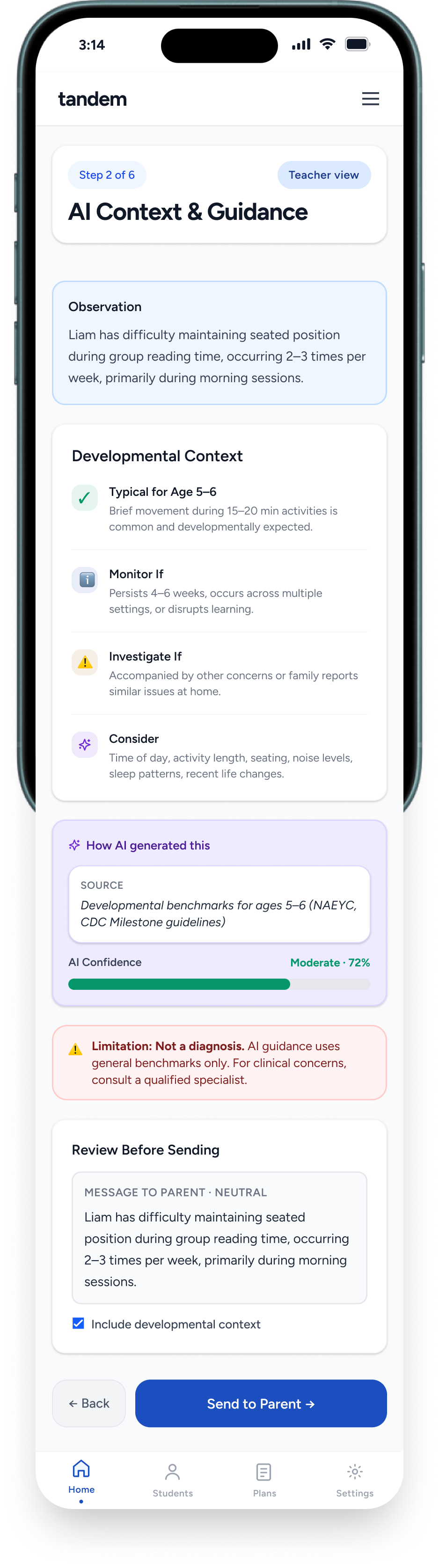
AI Context & Guidance: the AI frames the note against developmental benchmarks, cites its source and confidence, and marks a hard Not a diagnosis limit before the teacher sends

The copilot reframes the note into developmental context, citing its source and confidence, and never diagnosing.

Detail · where the safeguards live

The responsible-AI story isn't in the copy: it's in two screens.

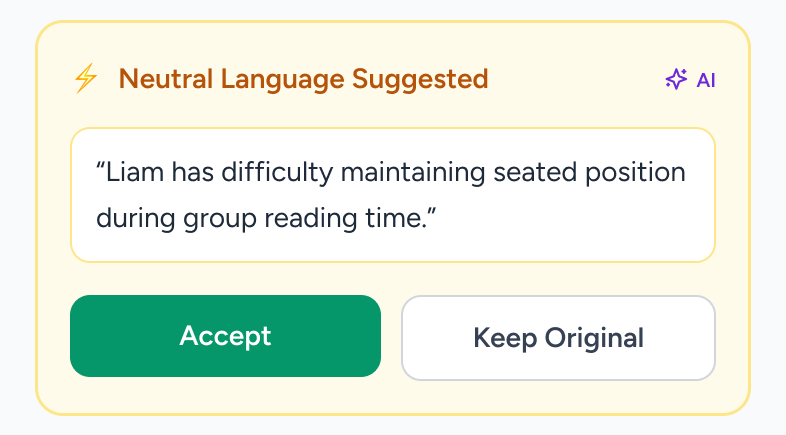
Neutral Language Suggested: the AI rewrites the teacher's raw note, with Accept or Keep Original buttons

Translate, don't dictate. The AI rewrites the teacher's raw note into neutral language, but Accept / Keep Original leaves the final call with the teacher.

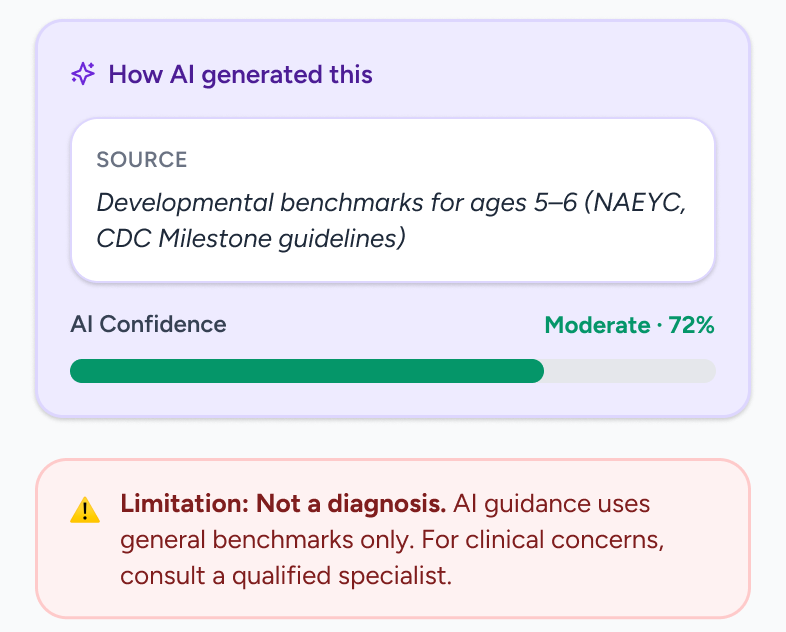
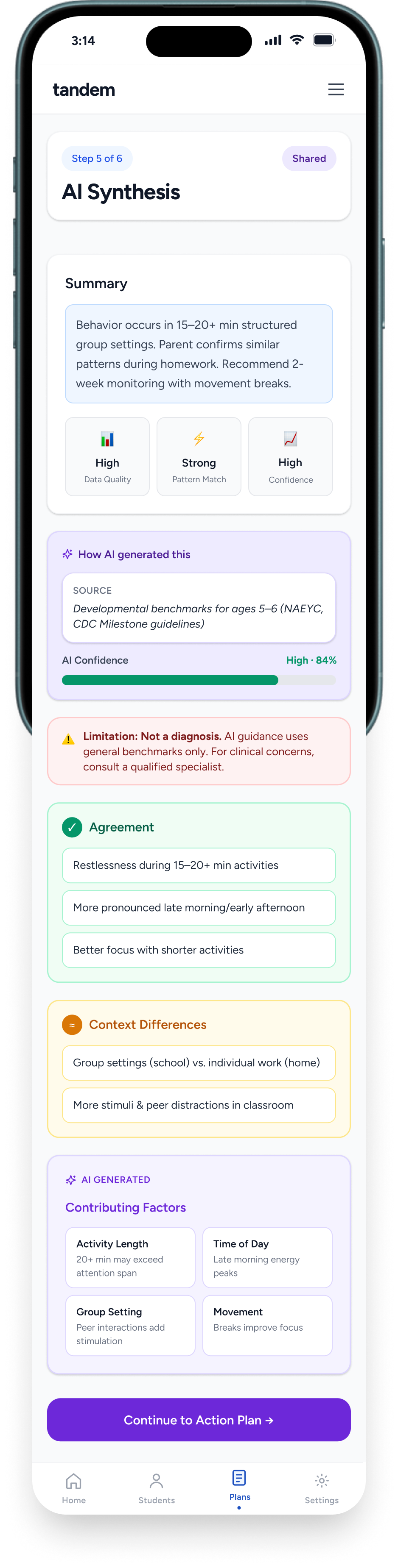
How AI generated this: cited source and confidence, above a Not a diagnosis limitation banner

Show the work, name the limit. Every AI suggestion cites its source and confidence, and a standing “Not a diagnosis” banner draws the hard line.

Decision · 03

Turn one-way feedback into a shared plan

Insight

Parents and teachers see the child in different worlds and define involvement differently, yet feedback today flows in only one direction.

Decision

Give parents a structured way to add their home perspective, then co-create an editable action plan split across school and home.

Solution

The final act makes the exchange two-way and ends in something concrete:

  1. Two-way: parents add what they see at home through focused prompts, enough to balance the picture without becoming a form.
  2. Aligned action: an editable plan split into school-side and home-side steps, so responsibility is shared.
  3. Follow-through: lightweight reminders and check-ins keep the plan alive past the first conversation.

Outcome

The exchange becomes collaborative instead of one-directional. In our later evaluation, the teacher called the shared action plan the most valuable part: "it focuses on solutions together instead of only pointing out problems."

Two-way

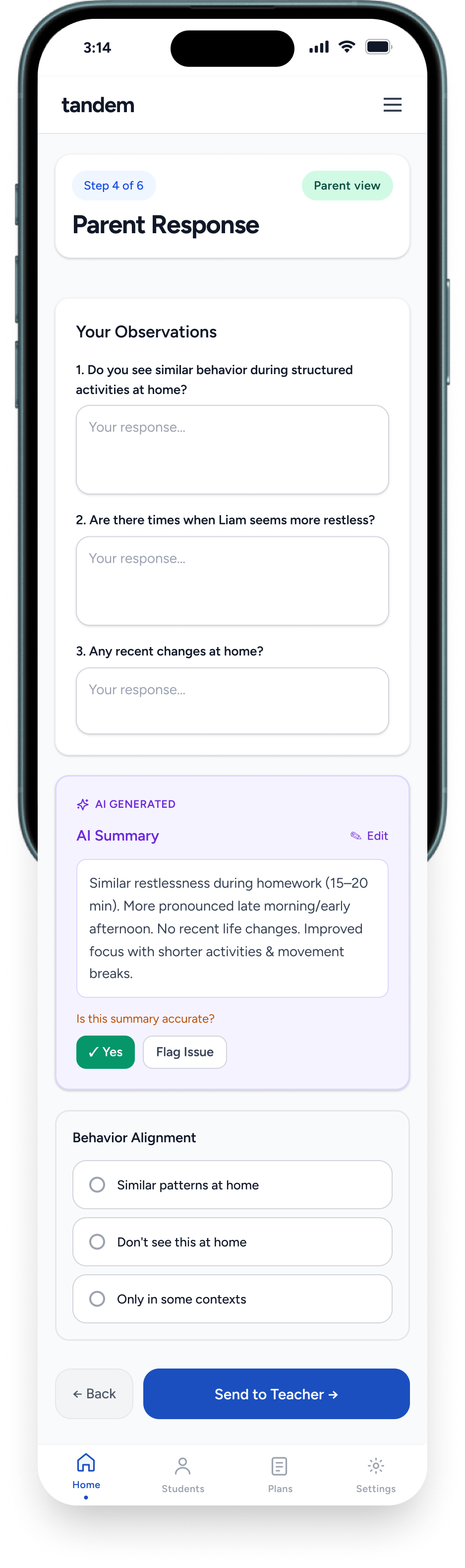
Parent Response: focused prompts let the parent add what they see at home, with an AI summary and behavior alignment

Parents add what they see at home through focused prompts: the first time feedback flows both ways.

Together, the three moves turn a twice-a-year verdict into a continuous, low-stakes loop (observe, translate, align), with the child, not the tool, at the center.

05 · Evaluation

A concept, stress-tested: three synthetic personas, each surfacing a real fix.

Tandem didn't ship. We evaluated it with three research-grounded synthetic personas (built from our interviews, run as AI-simulated users), an AI-assisted heuristic & risk review, and a think-aloud with one real teacher. These are design-validation signals, not measured outcomes.

Sarah

The overwhelmed novice teacher

Surfaced

Caught the AI defaulting to clinical terms like "executive function": language she'd never send a parent.

Drove

A bias-aware language safeguard and a mandatory teacher review before anything sends.

David

The impulsive, search-reliant parent

Surfaced

The default "Neutral, factual" phrasing read as cold to an anxious parent; without softening, a routine note risked sending him straight to late-night Googling.

Drove

A tone selector (Neutral / Warm / Direct) and leading with the child's strengths, so the message lands as support, not a verdict.

Elena

The skeptical, strategic parent

Surfaced

Liked the collaborative tone but wanted to see how the AI reached its conclusions.

Drove

Reinforced the case for visible reasoning: the transparency panel.

If it shipped: the outcomes the design targets

01Fewer blindsided, defensive parents.
02Less teacher time lost to managing misinterpretation.
03Earlier, calmer intervention before concerns escalate.
04Parents positioned as partners, not obstacles.

Intended outcomes the design targets, useful for surfacing edge cases, but no substitute for real classrooms.

06 · Reflection

In a tool about someone's child, the riskiest thing the AI can do is sound certain.

Our evaluation leaned heavily on AI-simulated users. The synthetic personas surfaced real edge cases, but their reactions came out tidy and a little theatrical; prompt wording alone could swing them from glowing to harsh. I treated their output as hypotheses, not findings, and grounded them against a real teacher walkthrough. The concept itself is unvalidated in a real classroom.

What I learned

  • The hard part wasn't the AI's capability; it was its tone. The copilot had to translate without ever sounding like a diagnosis.
  • Transparency and a visible human-in-the-loop did more for trust than raw accuracy.
  • During the AI-assisted heuristic and risk review, the AI said to strip the teacher's input fields to save time; I pushed back, since those fields were the source of the message's accuracy.

My next steps

  • Define evaluation prompts and a testing framework up front, so synthetic responses are comparable.
  • Bring real teachers and parents in early, not just at the end.
  • Build the bias-aware language safeguard as a real system rule, not a guideline.

Tandem didn't ship, but it changed how I design with AI: the model earns trust by staying a draft, not an authority.

Walk the full six-step flow
The full journey

All six steps, one continuous loop: observe, translate, align.

The whole experience, end to end: the teacher logs once, the AI translates and shows its work, the parent adds their view, and both approve a shared plan.

Observe

Step 1: Log Observation
Step 01

Log the observation

The teacher logs one structured note: the concern, how often, and the child's strengths. Nothing automated yet; this is the human input the rest builds on.

Communicate

Step 2: AI Context & Guidance
Step 02

AI adds context and shows its work

The AI frames the note against developmental benchmarks, names its source and confidence, and draws a hard line: never a diagnosis.

Step 3: Message from Teacher
Step 03

A warm message reaches the parent

After the teacher reviews and approves, the parent receives a plain-language message, with context and a few questions to answer.

Act

Step 4: Parent Response
Step 04

The parent adds their view

Focused prompts let the parent share what they see at home; the AI summarizes both sides for them to confirm.

Step 5: AI Synthesis
Step 05

Both views, synthesized

The AI lays out where home and school agree, where they differ, and the factors worth watching; confidence rising as the picture fills in.

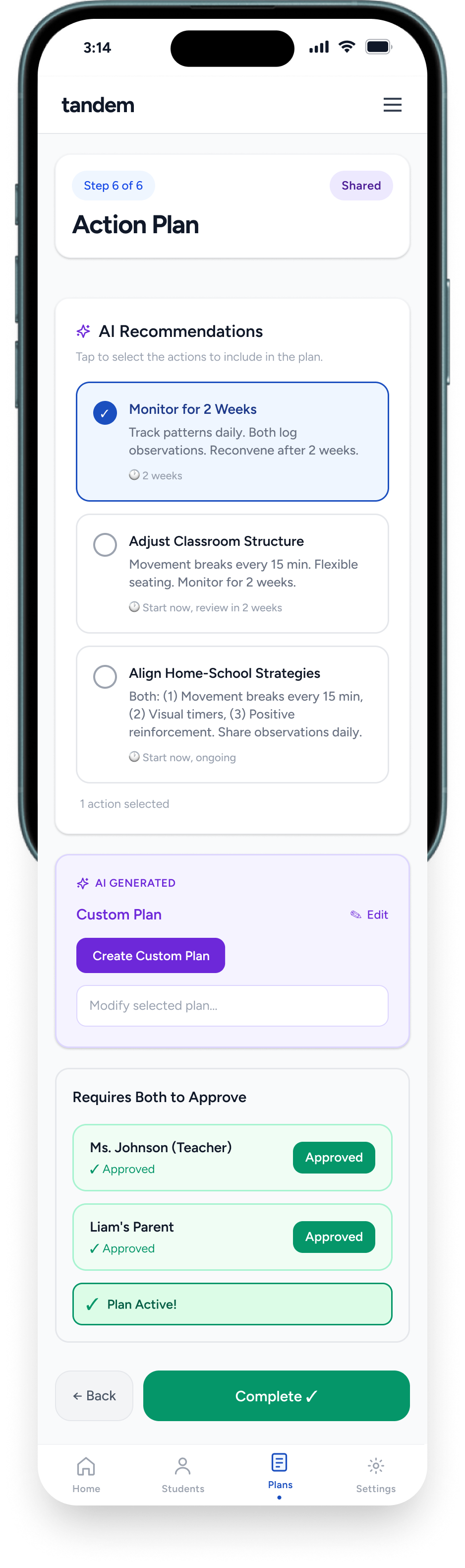
Step 6: Action Plan
Step 06

A shared plan, both approve

Teacher and parent co-create an editable plan split across school and home. Nothing goes live until both sign off.