Back to work

Tandem

An AI copilot that helps teachers turn classroom observations into warm, clear messages, and a plan parents and teachers build together.

Team of 5

~5 weeks

Figma · Figma Make · ChatGPT · Claude

Product Design · Research Synthesis · AI Prototyping · Risk Evaluation

The starting point

40 min

of teacher contact per family, in a whole year

Per teacher

20+

families to keep up with at once

The research

6 studies

peer-reviewed, behind every design decision

~4 min read· 7 sections
01 · Snapshot

An AI helper with one rule it can't break: explain what the teacher saw, never diagnose it.

Challenge

Parents and teachers get about 40 minutes together a year. A short note from school gets misread, parents feel caught off guard, and small worries grow before anyone talks.

Solution

A step-by-step flow that goes from noticing to talking to acting. The AI turns teacher shorthand into warm, plain language, and both sides end with a shared plan. The teacher always has the final say.

My role

I was one of five on the team. I pulled the research together, prototyped the full flow, and led the review of where the AI could go wrong.

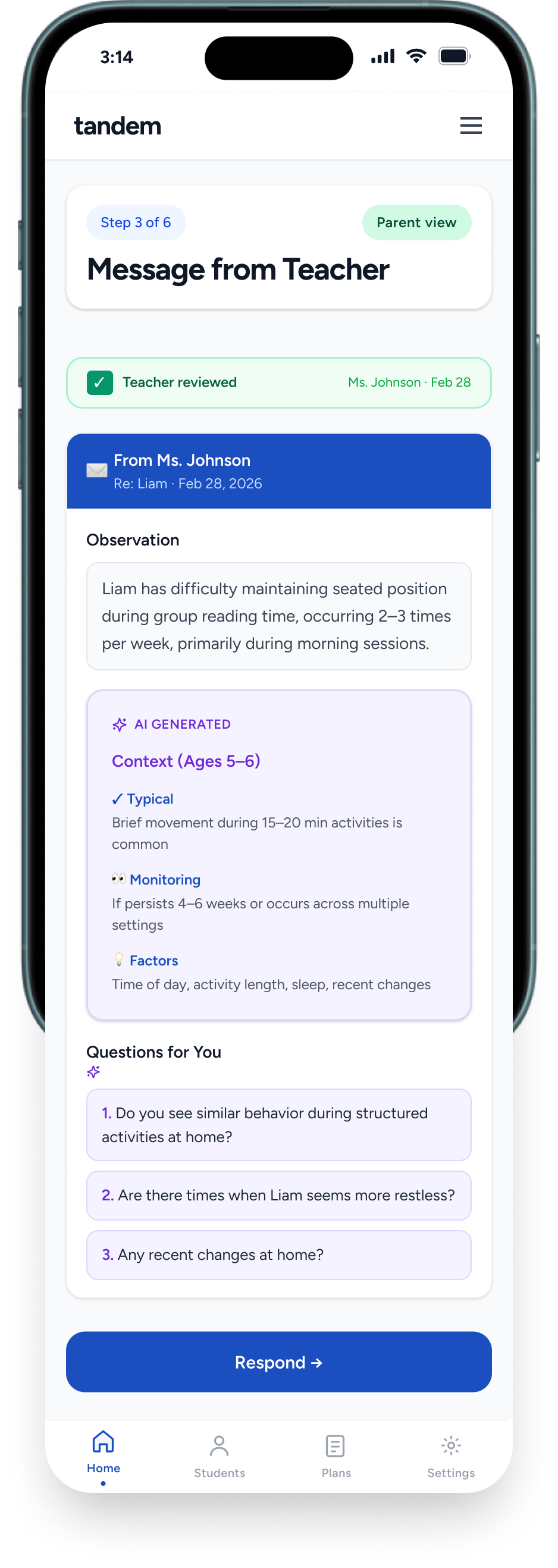
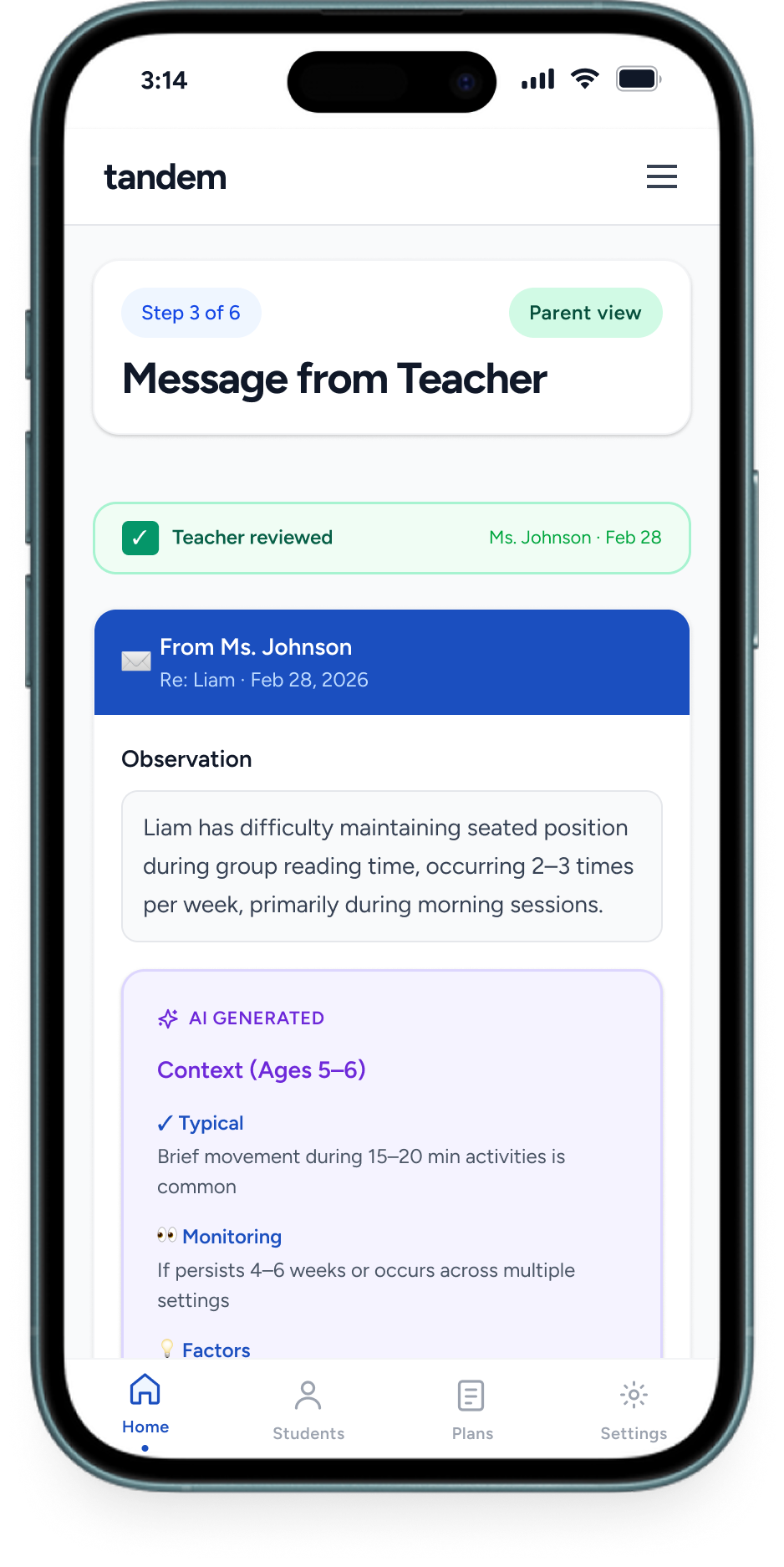
Message from Teacher: the parent's view

Message from Teacher: the parent's view

02 · Problem

Two people who love the same child, speaking two different languages.

What the teacher sees

Structured behavior in the classroom: focus, peer interaction, how a child handles group time.

One child the gap

What the parent sees

A different world at home (routines, mood, what the day cost), with no window into the classroom.


Each of them holds half the picture.
There's no easy, low-pressure way to put the halves together.

01Notes are too short for parents to act on.
02Teacher language sounds alarming out of context.
03Concerns come up late, at conferences, when they already feel serious.
04Parents fill the silence with late-night searching.
03 · Research

Everyone agrees the gap exists. I wanted to know why it sticks around.

The three methods

Tap a method to see what we found.

We read six studies on parent–teacher communication. AI helped summarize them; I grouped the themes myself.
  • Greater parent–teacher perception gaps correlate with lower social and cognitive outcomes; the misalignment itself has measurable consequences (Jensen et al., 2025).
  • The early-elementary years (ages 3–10) are a critical, high-impact window for getting alignment right.
  • Parents and teachers define "engagement" differently, so each can read the other as not involved enough (Fisher & Baissberg, 2025).
A semi-structured interview with a mother of two children (ages 5 and 7) in a private-school setting.
  • Relies primarily on biannual conferences; contact outside them is reactive.
  • Has limited visibility into the child's social world at school.
  • Fills knowledge gaps with online searches and parenting forums, which amplify anxiety.
  • Asked, unprompted, for structured question prompts to bring to conferences.
A semi-structured interview with an early-elementary teacher about how they raise and frame concerns with families.
  • Waiting until conferences makes parents feel blindsided; early, low-stakes notes reduce defensiveness.
  • "Productive struggle" and routine developmental comments are frequently misread as alarming.
  • Parents have almost no window into the classroom's social landscape.
Key findings
01

Nobody here is the bad guy

Both adults care. They just see the child in different places. More goodwill won't fix that; a shared way to compare notes might.

02

Parents don't need more updates

They need the ones they get to make sense. “Productive struggle” means growth to a teacher and trouble to a parent.

03

The parent asked for questions, not answers

Without prompting, she asked for prompts to bring to conferences. She wanted a way into the conversation, not a report.

04 · Design

What I designed, and why.

Decision · 01

A calm, three-step journey

Insight

Everything gets said at once, late, at a conference. Teachers are short on time and parents feel ambushed.

Decision

Split it into three small steps: the teacher notes what they saw, the parent gets a clear message, and together they decide what to do.

Outcome

Nobody has to carry the whole conversation at once. The teacher we tested with, and all three personas, found the flow easy to follow.

3 acts
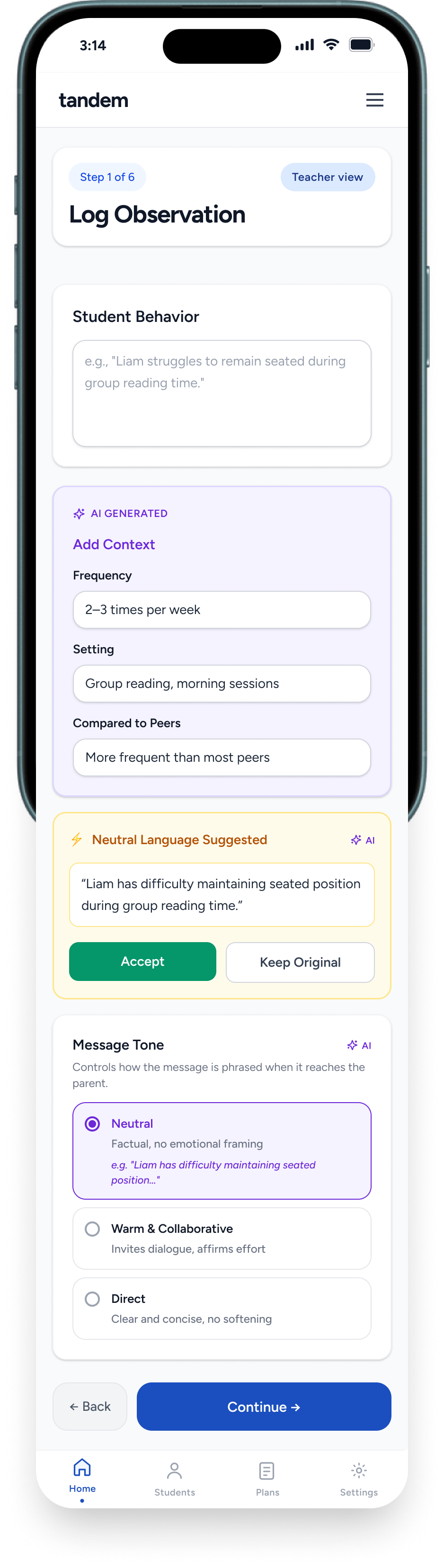
Observe: teacher logs an observation with behavior, frequency, context, and tone

Observe: the teacher logs one structured observation.
Decision · 02

An AI that translates, never diagnoses

Insight

The real problem was wording. And when the topic is a child's behavior, an AI that sounds clinical can do real harm.

Decision

Let the AI draft a warm, plain-language message from the teacher's notes. It shows how it got there, the teacher can change the tone, and nothing sends until the teacher approves it.

The hard rule: Tandem never diagnoses or names a condition. It starts with the child's strengths, and points families to a professional when something is serious.

Outcome

The fix was never a smarter model. It was keeping the teacher in front of it.

The copilot

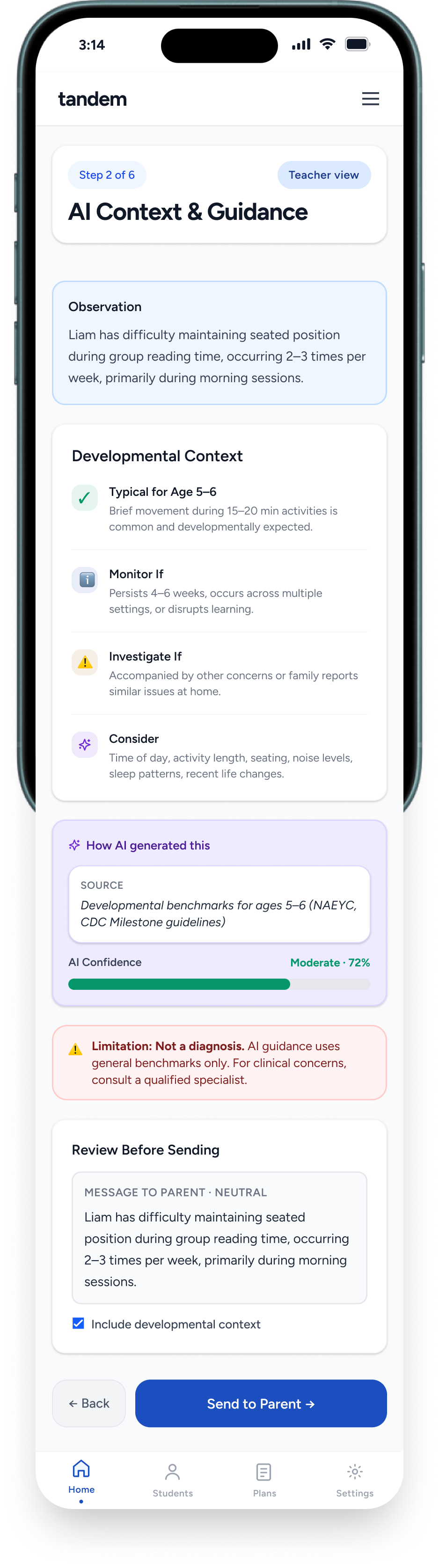
AI Context & Guidance: the AI frames the note against developmental benchmarks, cites its source and confidence, and marks a hard Not a diagnosis limit before the teacher sends

The copilot reframes the note into developmental context, citing its source and confidence, and never diagnosing.

Detail · where the safeguards live

Two screens do most of the work of keeping the AI honest.

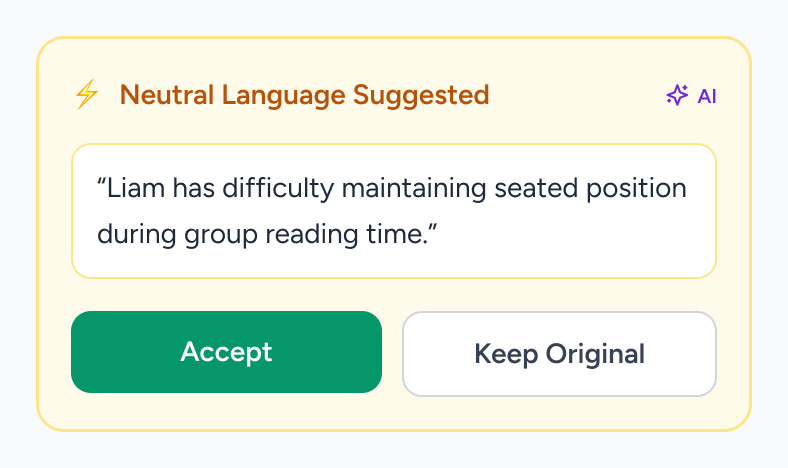
Neutral Language Suggested: the AI rewrites the teacher's raw note, with Accept or Keep Original buttons

Suggest, don't decide. The AI offers a softer rewrite. The teacher can accept it or keep their own words.

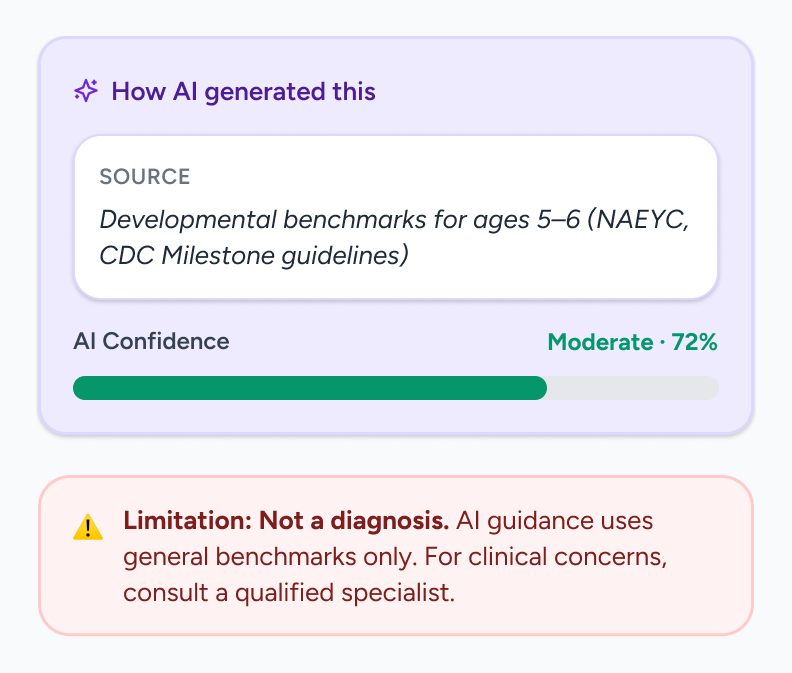
How AI generated this: cited source and confidence, above a Not a diagnosis limitation banner

Show the work. Every suggestion lists its source and how sure it is, under a standing “Not a diagnosis” banner.

Decision · 03

A plan both sides make

Insight

Feedback only ever went one way, from school to home.

Decision

Let parents add what they see at home, then build a plan together with steps for school and steps for home.

Outcome

The teacher we tested with called the plan the most useful part: “it focuses on solutions together instead of only pointing out problems.”

Two-way

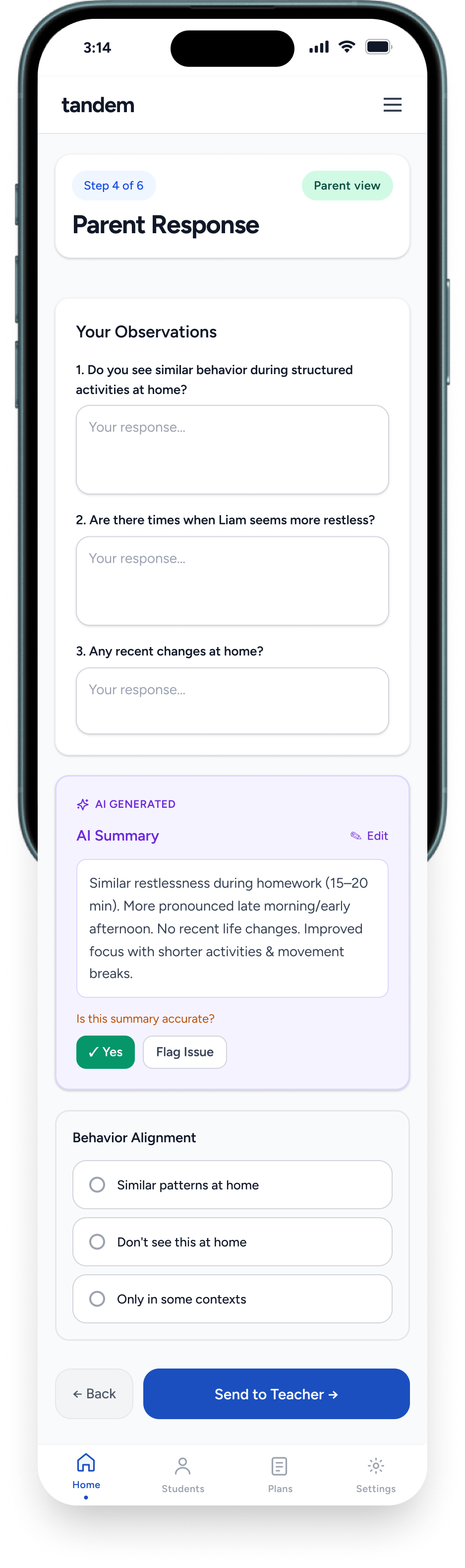
Parent Response: focused prompts let the parent add what they see at home, with an AI summary and behavior alignment

Parents add what they see at home through focused prompts: the first time feedback flows both ways.

05 · Evaluation

Three simulated users, three real fixes.

Tandem didn't ship. I tested it with three AI-simulated users based on our interviews, plus a think-aloud with one real teacher. Treat these as early signals, not results.

“It focuses on solutions together instead of only pointing out problems.”
Elementary teacher, think-aloud walkthrough

Sarah

The overwhelmed novice teacher

Surfaced

Caught the AI using terms like “executive function” that she'd never send a parent.

Drove

A language check, and a required teacher review before anything sends.

David

The impulsive, search-reliant parent

Surfaced

The default wording felt cold. A routine note could send him straight to Google at midnight.

Drove

A tone picker (Neutral, Warm, Direct), and messages that open with the child's strengths.

Elena

The skeptical, strategic parent

Surfaced

Liked the tone, but wanted to know how the AI reached its conclusions.

Drove

The “How this was created” panel.

06 · Reflection

In a tool about someone's child, the riskiest thing the AI can do is sound certain.

Most of our testing used AI-simulated users. They found real edge cases, but their reactions were a bit too neat, and changing the prompt could flip them. I treated what they said as ideas to check, not proof. Tandem still needs a real classroom.

What I learned

  • The hard part wasn't what the AI could do. It was how it sounded.
  • Showing the reasoning built more trust than being more accurate.
  • When an AI review told me to cut the teacher's input fields to save time, I pushed back. Those fields are what make the message accurate.

What I'd do next

  • Set the test prompts up front so simulated answers can be compared.
  • Bring in real teachers and parents early.
  • Build the language check into the system, not just the guidelines.

Tandem didn't ship, but it changed how I design with AI. It earns trust by staying a draft.

See the full six-step flow
The full journey

The whole thing, start to finish.

The teacher writes one note. The AI explains it, the parent adds what they see at home, and both sign off on a plan.

ObserveStep 01 / 06

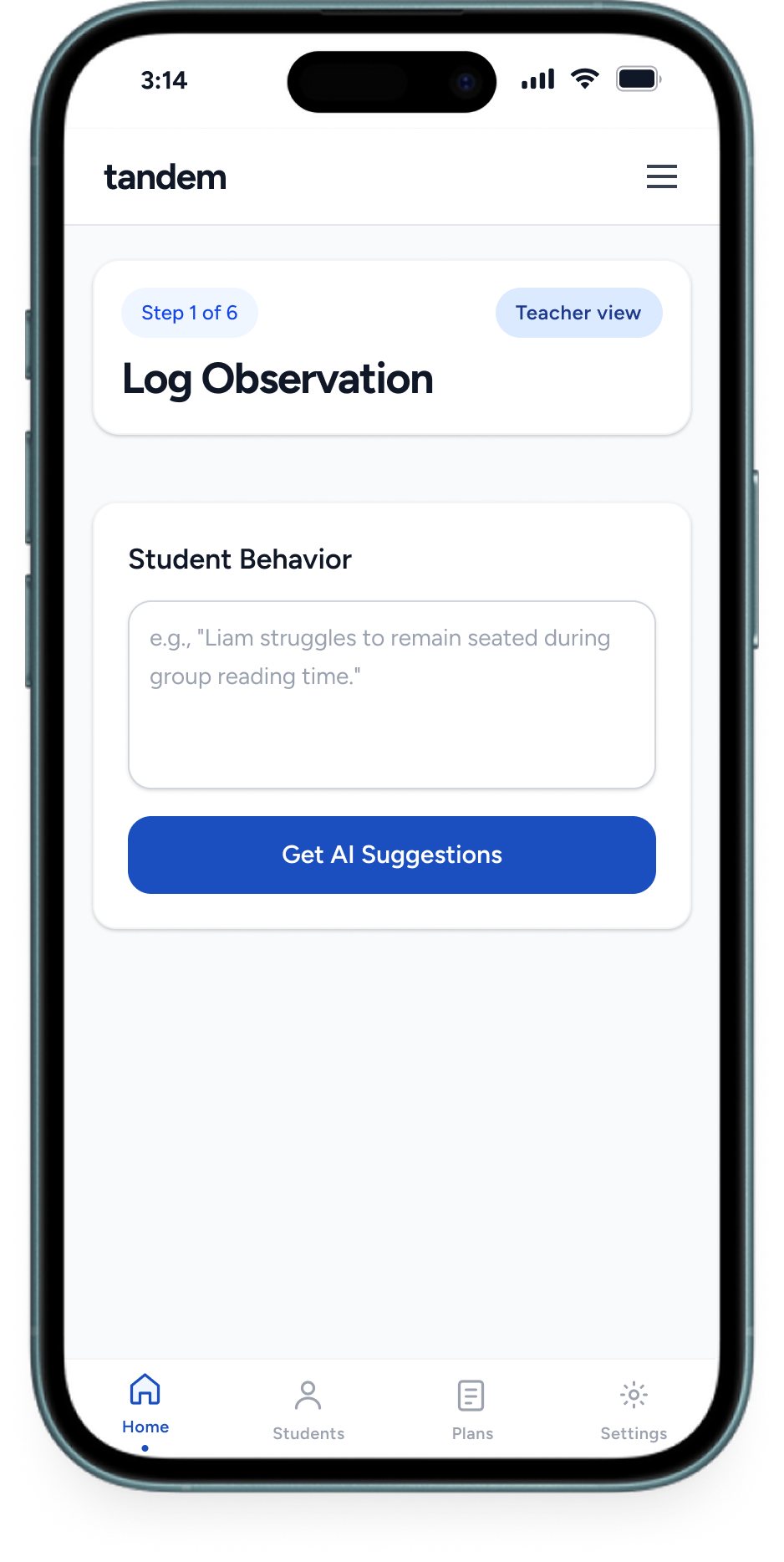
Log the observation

The teacher logs one structured note: the concern, how often, and the child's strengths. Nothing automated yet; this is the human input the rest builds on.

Step 1: Log ObservationClick to see full screen
CommunicateStep 02 / 06

AI adds context and shows its work

The AI frames the note against developmental benchmarks, names its source and confidence, and draws a hard line: never a diagnosis.

Step 2: AI Context & GuidanceClick to see full screen
CommunicateStep 03 / 06

A warm message reaches the parent

After the teacher reviews and approves, the parent receives a plain-language message, with context and a few questions to answer.

Step 3: Message from TeacherClick to see full screen
ActStep 04 / 06

The parent adds their view

Focused prompts let the parent share what they see at home; the AI summarizes both sides for them to confirm.

Step 4: Parent ResponseClick to see full screen
ActStep 05 / 06

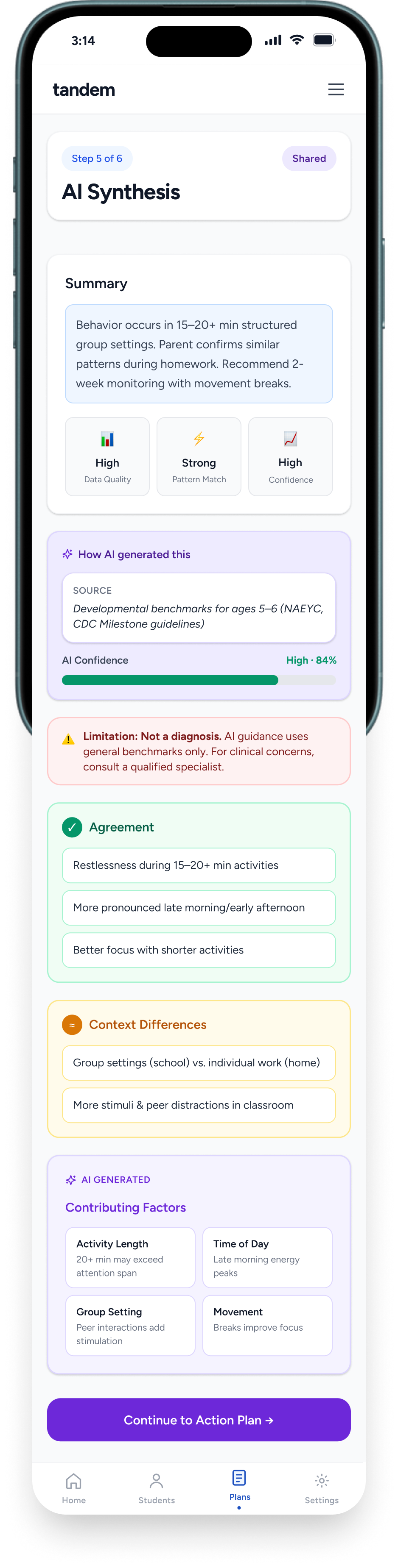
Both views, synthesized

The AI lays out where home and school agree, where they differ, and the factors worth watching; confidence rising as the picture fills in.

Step 5: AI SynthesisClick to see full screen
ActStep 06 / 06

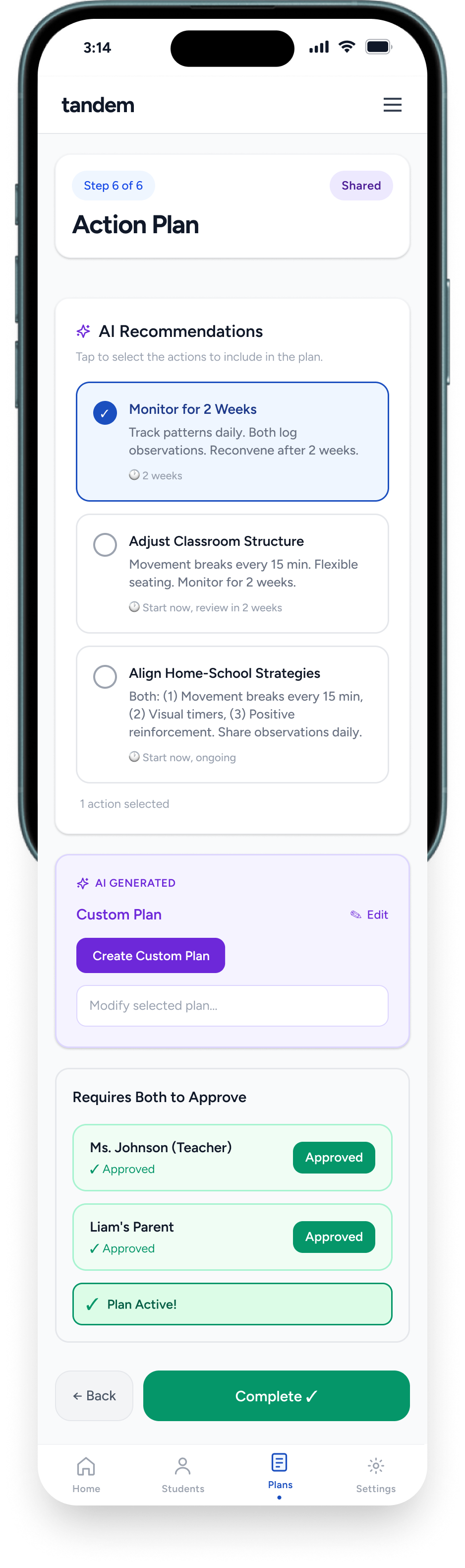
A shared plan, both approve

Teacher and parent co-create an editable plan split across school and home. Nothing goes live until both sign off.

Step 6: Action PlanClick to see full screen
↑