Back to work

Start Simple with MyPlate

Making it easy to log a meal, set a goal that fits, and actually see your progress.

Team of 5

10 weeks

Figma · FigJam ·
OpinionX · Maze

Feature redesign · Research · Prototyping

Core-task completion

60%83%

of people finished the basics

System Usability Scale

74.577.5

from “fair” to “good”

Comprehension

6/6

understood every redesigned screen

~2 min read· 6 sections
01 · Snapshot

I helped redesign MyPlate so logging a meal and setting a goal actually felt doable.

Challenge

MyPlate had solid advice from the USDA, but you couldn't log a meal, the goals were the same for everyone, and there was no real way to see how you were doing. In our first test, 2 of 5 people got stuck on basic tasks.

Solution

I focused the redesign on what people asked for most: easier food logging, goals that fit the person, and progress you can check by day, week, or month.

My role

I was one of five on the team. I led the feature design, ran a survey with 38 people to rank features, built the prototype, and ran the concept test.

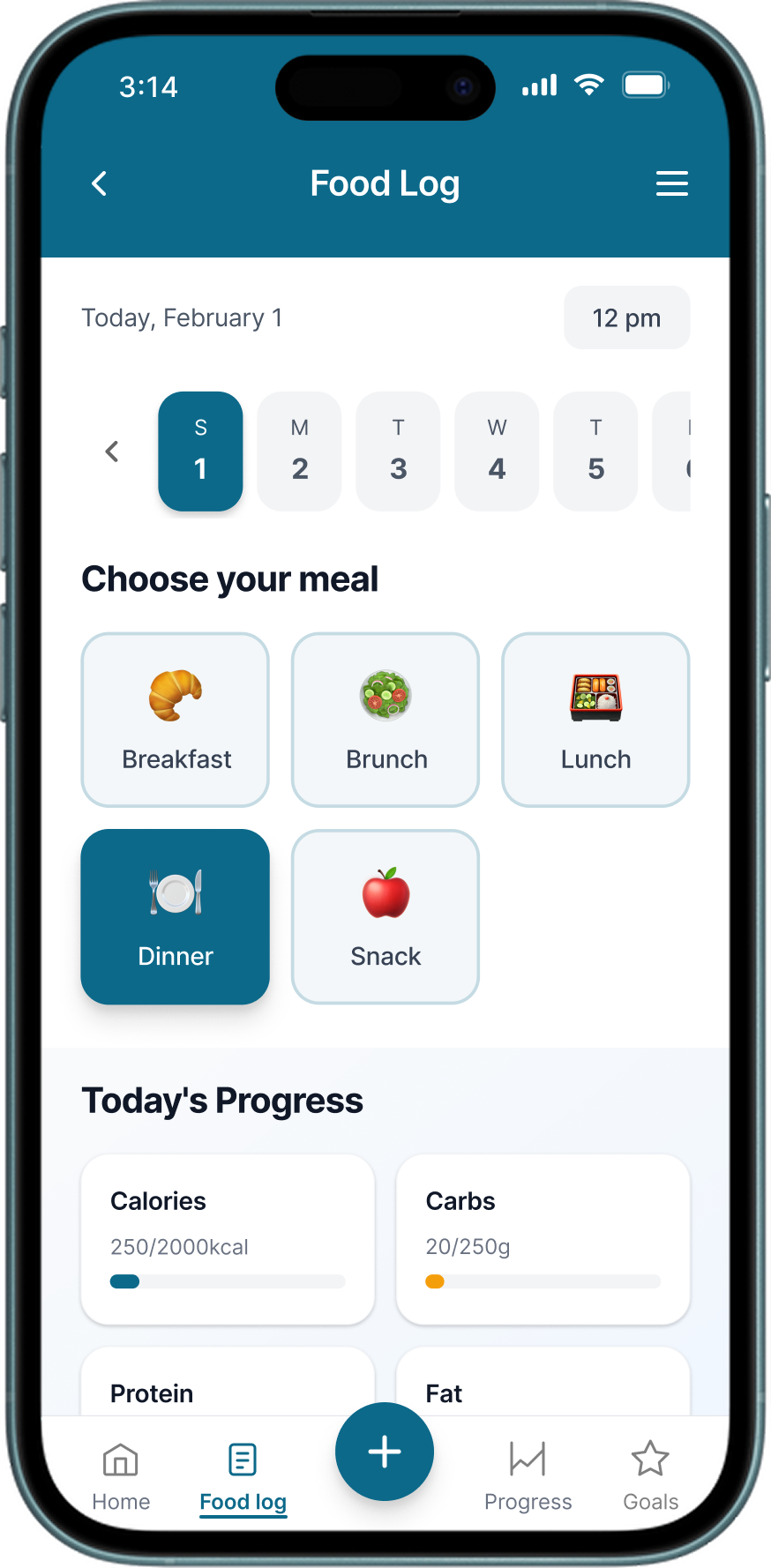
Redesigned meal logging

Redesigned meal logging

02 · Problem

Healthy eating shouldn't feel this complicated.

40%

of participants failed to complete essential tasks in round-one usability testing, limiting the app’s ability to support consistent habits.

01Key actions were hidden, so users had to hunt for them.
02No simple way to log what they actually ate.
03Generic targets that didn't feel like their own.
04No sense of whether they were making progress.

For a habit-building app, it wasn't helping anyone build habits.

03 · Research

We looked at the problem five different ways, and a few things surprised us.

The five methods

Tap a method to see what we found.

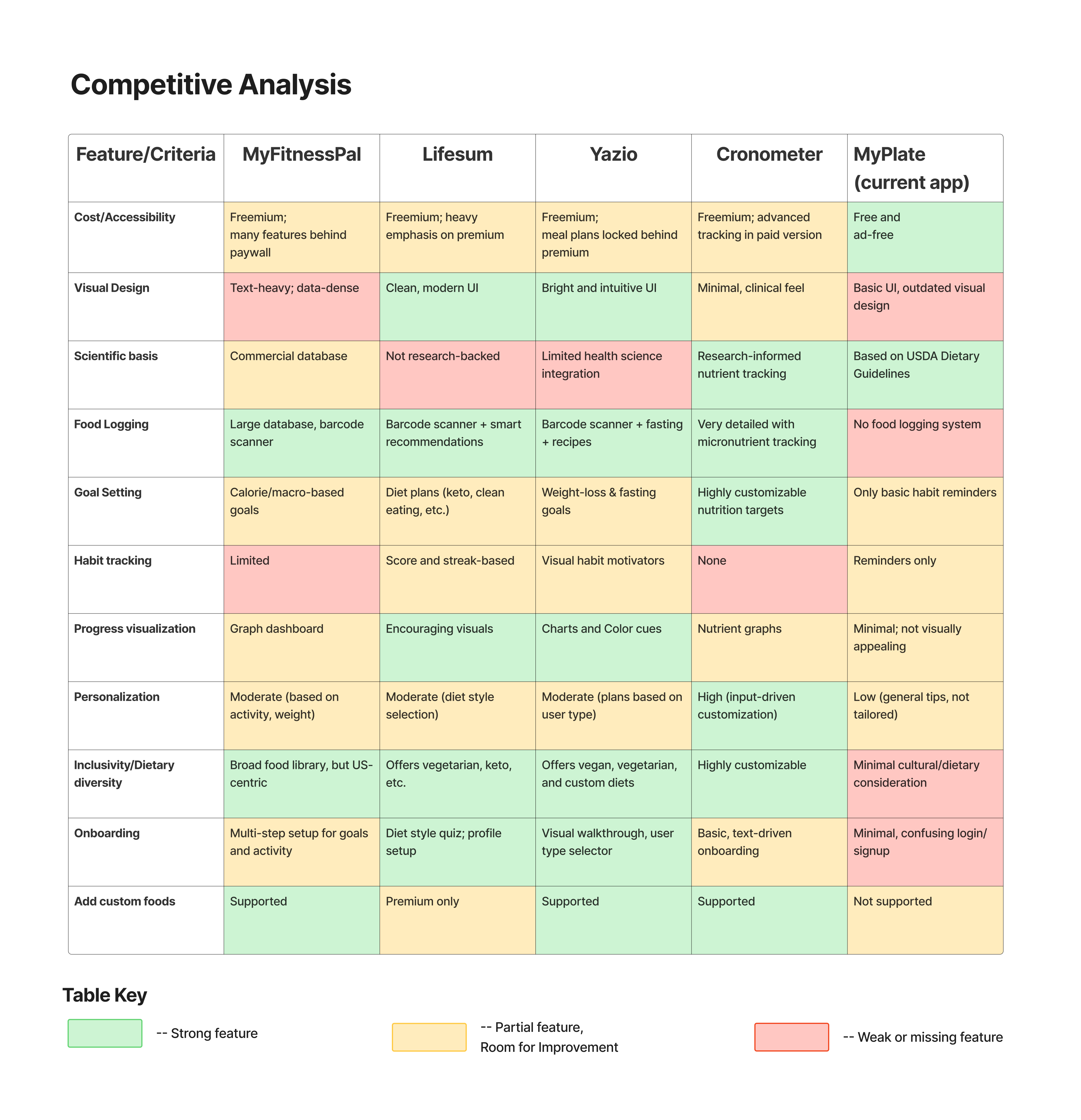
Benchmarked MyPlate against MyFitnessPal, Lifesum, Yazio, and Cronometer across logging, personalization, habit tracking, progress, and onboarding. Strengths: free, ad-free, USDA-backed. Gaps: no food logging, no personalization, dated progress views, no modern onboarding. Implication: add flexible logging, personalized goals, clear progress feedback.
Feature-by-feature comparison across five nutrition apps
Feature-by-feature comparison across five nutrition apps.
We analyzed app-store reviews and online discussion to gauge how people felt about MyPlate in the wild.
68%
22%
10%
Negative Positive Neutral
  • Users trusted the USDA-backed content, but many found the app hard to use day-to-day.
We watched five people try three core tasks in the app.

“It doesn't feel like it accounts for my being vegetarian.”

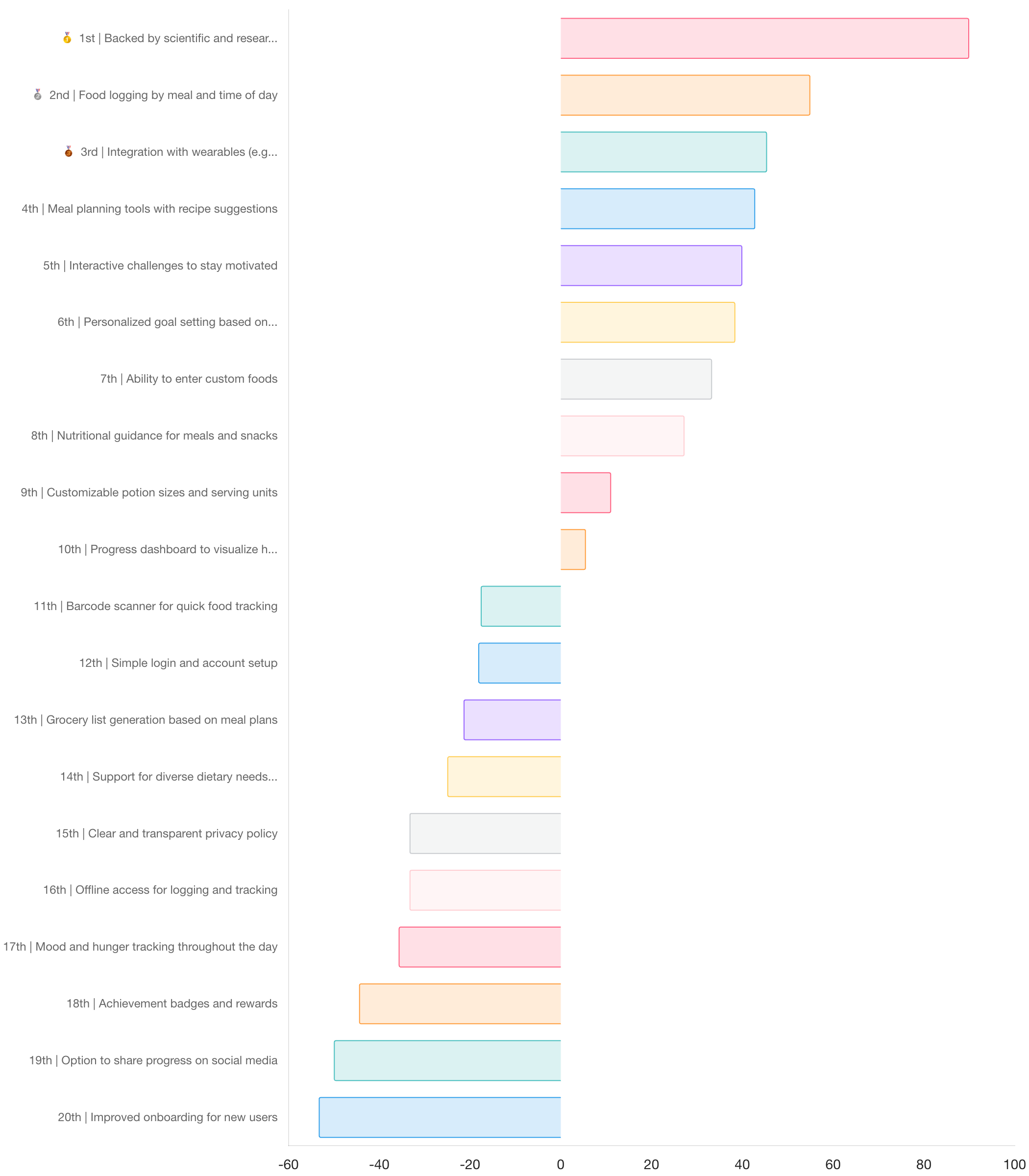
Forced-choice trade-offs (OpinionX) ranked a feature pool drawn from the earlier methods.
  • Top: evidence-based guidance, personalized goals, custom food entry, flexible logging.
  • Bottom: badges/streaks, social sharing.
  • Implication: focus on logging, goals, and guidance, not gamification.
MaxDiff best-worst feature ranking
Most and least important features by Best/Worst score (38 participants).
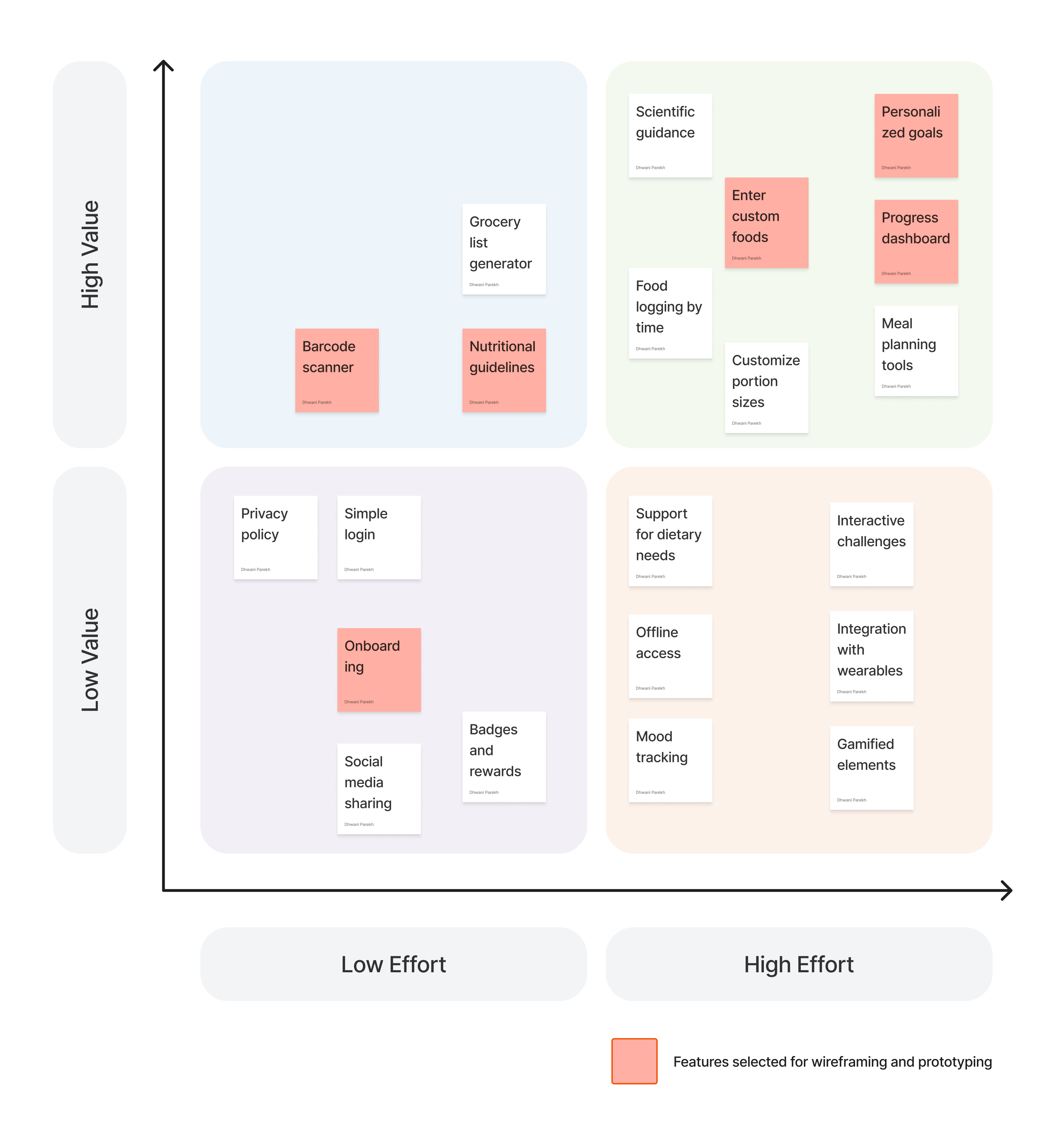
Plotted MaxDiff value against build effort.
  • Build first / next: barcode scanner, personalized goals, custom foods, progress dashboard.
  • Skip: social feed, public sharing.
Value vs effort priority matrix
Value-vs-effort matrix used to sequence the build.
Key findings
01

Trust wasn't the problem

People trusted the USDA advice. 68% of reviews were still negative, and they were about the app, not the content. So we kept the guidance and rebuilt the experience around it.

02

Nobody asked for streaks

Badges, streaks, and social sharing ranked last in our survey. People wanted guidance and control, so we left gamification out.

03

“Personal” meant how you eat

“It doesn't feel like it accounts for my being vegetarian,” one tester told us. Goals had to fit someone's diet, not just their numbers.

04 · Design

What I changed, and why.

Decision · 01

Flexible food logging

Insight

People wanted an easy way to log what they actually ate.

Decision

Give people four ways to add food: pick the meal, snap a photo, search, or type in something custom.

Outcome

It works just as well for a packaged snack as for a home-cooked dinner.

Before

No way to log a meal
The original app had no logging at all.

4 ways to log

Meal-based logging

Start by picking the meal: breakfast, lunch, dinner, or snacks.
Decision · 02

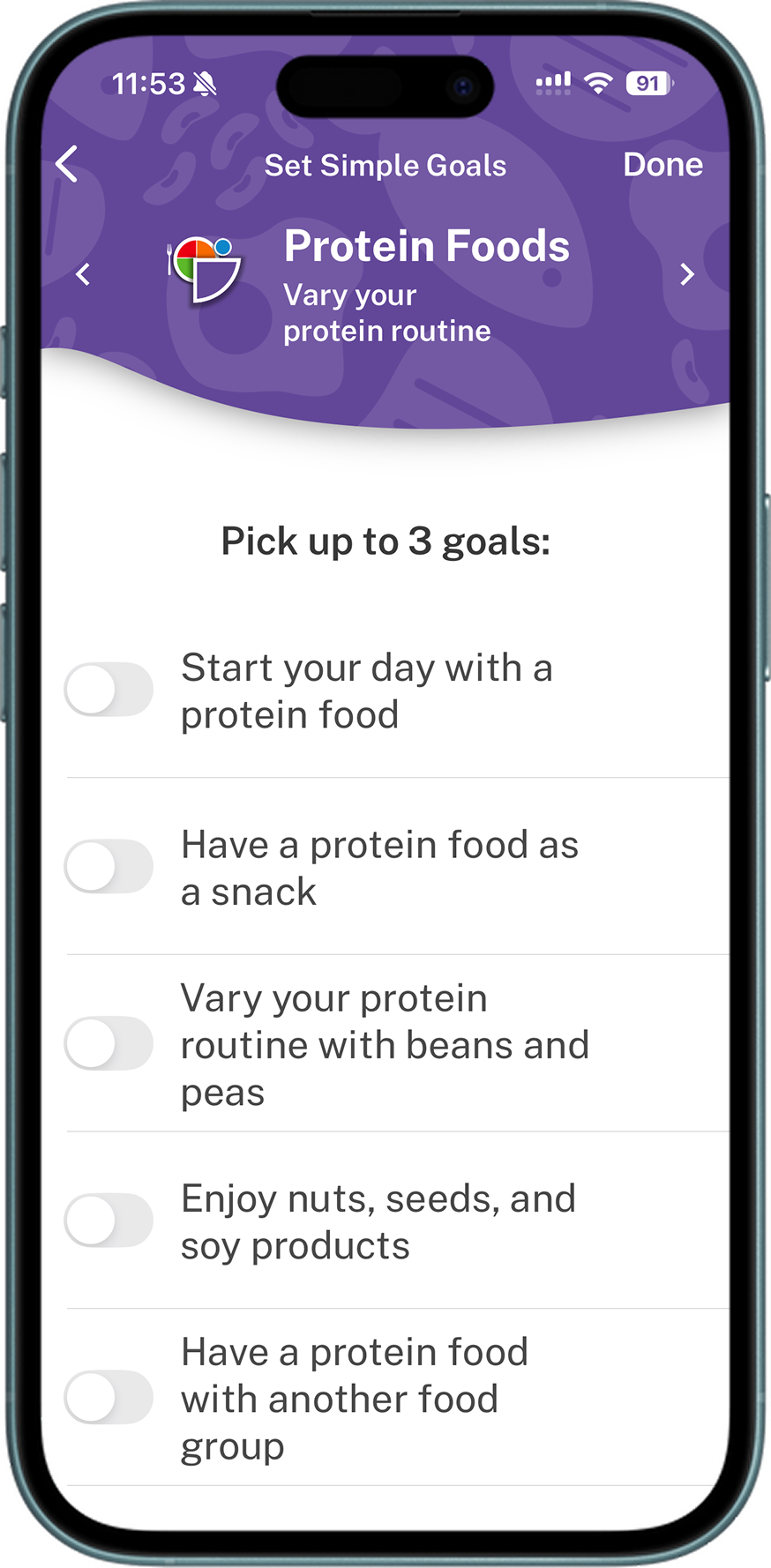
Personalized goals

Insight

A generic list of goals didn't motivate anyone.

Decision

Walk people through three quick choices: what they want to work on, which food groups to focus on, and how they'd like to track it.

Outcome

People ended up with goals that felt like their own, and getting started was easier.

Before

Original MyPlate goal setup
A generic list with no guidance on what fit you.

Prototype walkthrough

A three-step flow built around what motivates each user.

Decision · 03

Progress dashboard

Insight

It's hard to improve something you can't see.

Decision

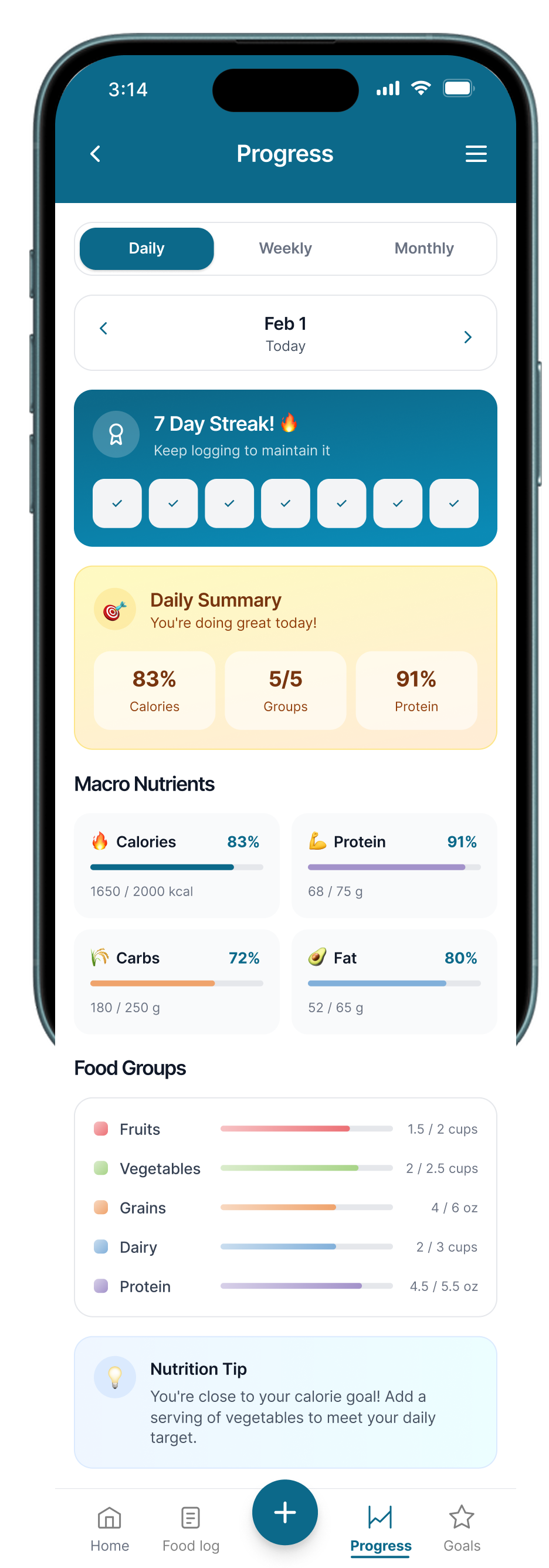
Show progress for today, this week, and this month.

Outcome

People could glance at the dashboard and know what to do next.

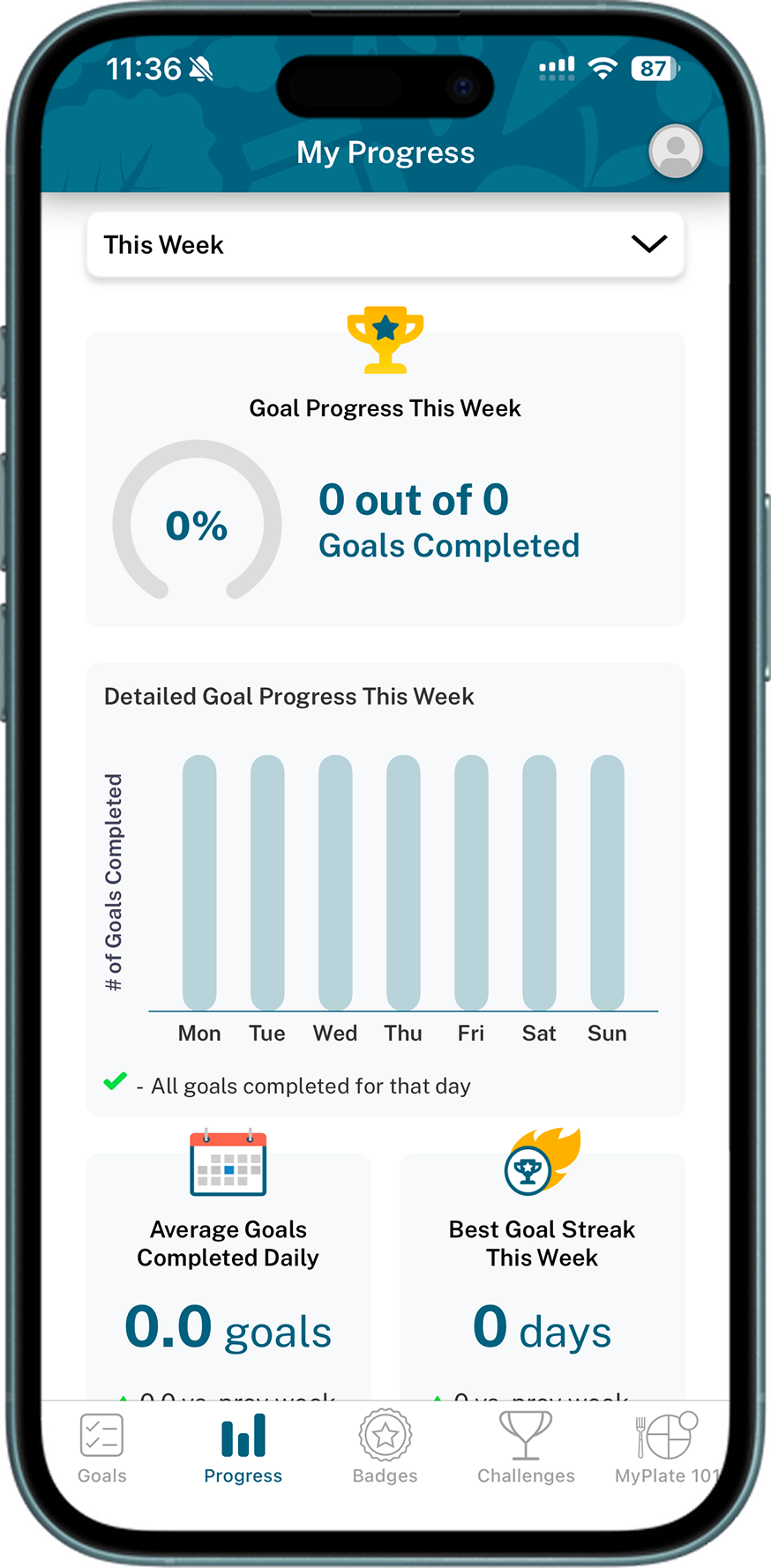
Before

Original MyPlate progress screen
Only a weekly summary.

3 progress views

Daily progress

Immediate feedback: see how today's intake tracks to goals.

05 · Results

The main idea held up in testing. Two things still need work.

I tested the new flows with six people. The targets are where I want to get next, not results already hit.

Core-task completion

The 40% failure rate is what I set out to fix.

Before
60%
After
83%

Target ≥ 90%

System Usability Scale

68 is average. 80+ is excellent.

Before
74.5
After
77.5

Target ≥ 80

Goal-setup ease (SEQ, out of 7)

Before, people weren’t sure which goal fit them.

After
5.0

Target ≥ 5.5

Validated

Entry point found on instinct

5 of 6 people went straight to the meal selector.

Iterate

Tracking-method step needs work

The “how to track” step confused 2 of 6 people. I'd reorder and relabel it, and allow more than one goal.

Validated

Progress read and acted on

The clearest flow (5.3/7). People could name their next step. Next I'd add reference ranges.

06 · Reflection

Research is only as honest as its sample.

Our testers were younger and more tech-savvy than the people who actually use MyPlate. Before calling any of this finished, I'd test it again with a wider group.

What I learned

  • You have to design for motivation from the start.
  • Flexible inputs work better than strict ones.
  • A careful method can't make up for a narrow sample.

What I'd do next

  • Test again with a broader group of people.
  • Suggest goals based on how someone is doing.
  • Send reminders at the moments people usually decide what to eat.
↑